


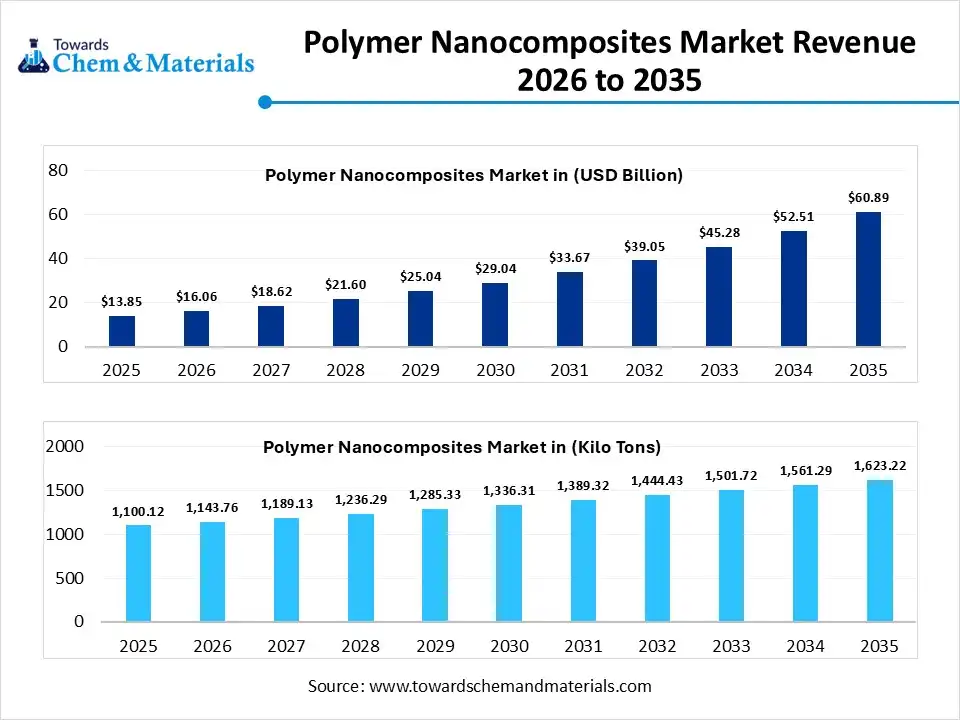
According to Towards Chemical and Materials, the global polymer nanocomposites market volume was valued at 1,100.12 kilo tons in 2025 and is expected to be worth around 1,623.22 kilo tons by 2035, exhibiting at a compound annual growth rate (CAGR) of 3.97% over the forecast period from 2026 to 2035.
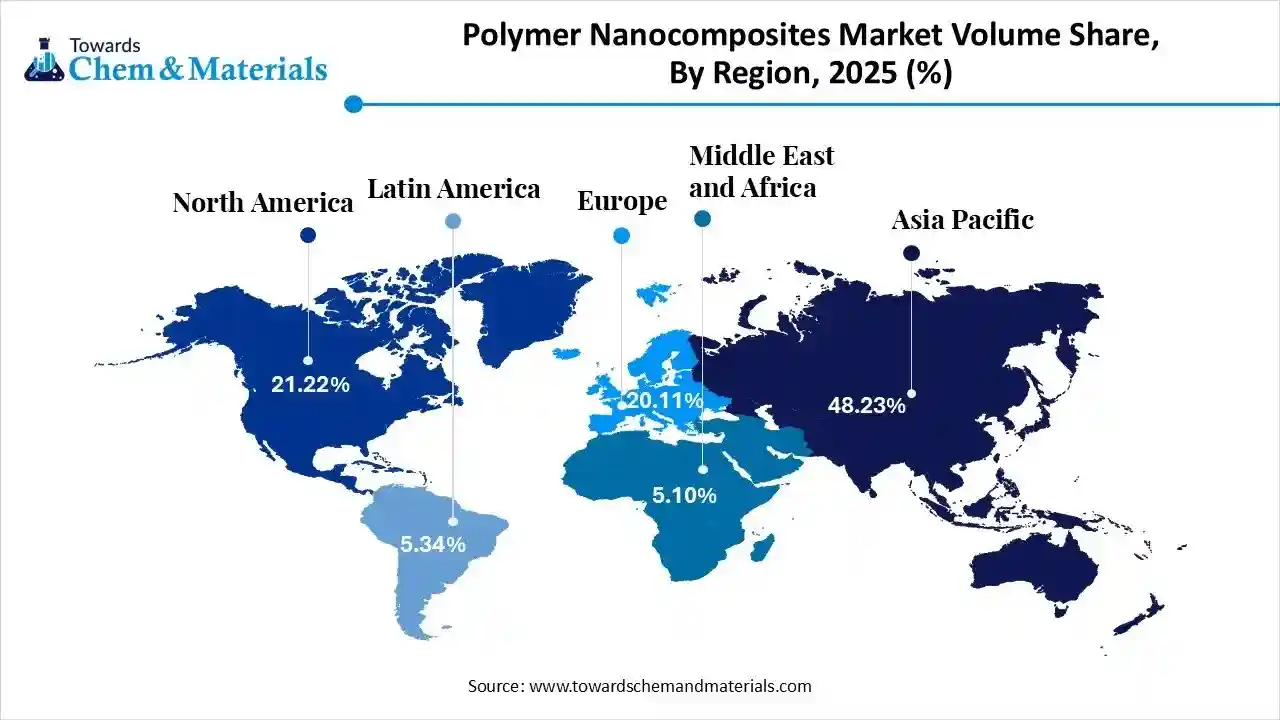
Ottawa, Feb. 02, 2026 (GLOBE NEWSWIRE) — The global polymer nanocomposites market size was estimated at USD 13.85 billion in 2025 and is expected to increase from USD 16.06 billion in 2026 to USD 60.89 billion by 2035, growing at a CAGR of 15.96% from 2026 to 2035. In terms of volume, the market is projected to grow from 1,100.12 kilo tons in 2025 to 1,623.22 kilo tons by 2035. growing at a CAGR of 3.97% from 2026 to 2035. Asia Pacific dominated the polymer nanocomposites market with the largest volume share of 48.23% in 2025. The market is driven by advancements in nanotechnology, demand for lightweight materials, rapid industrialization, and diversified applications. A study published by Towards Chemical and Materials a sister firm of Precedence Research.
Download a Sample Report Here@ https://www.towardschemandmaterials.com/download-sample/6145
Request Research Report Built Around Your Goals: [email protected]
What is Driving the Growth of the Polymer Nanocomposites Market?
The polymer nanocomposites market is growing rapidly due to the automotive, aerospace, electronics, and packaging industries requiring materials that are lightweight, strong, and versatile. While developments in 3D printing and sustainable polymers increase adoption, nanofillers such as carbon nanotubes and nanoclays improve the properties of polymers. Global market expansion is also being propelled by robust industrialization and R&D investments.
Private Industry Investments for Polymer Nanocomposites:
- Arkema: The company’s Nanostrength® and Graphistrength® products leverage block copolymers and carbon nanotubes to greatly improve toughness, impact resistance, and electrical conductivity in various applications.
- BASF SE: BASF integrates functional nanomaterials into its extensive polymer platforms, such as Ultramid® and Ultradur®, to deliver enhanced mechanical strength and thermal stability for automotive and electronic components.
- Cabot Corporation: Cabot focuses on high-performance additives like graphene nanoplatelets and fumed silica to provide excellent electrical and thermal conductivity and mechanical strength in a variety of composite systems, including batteries and coatings.
- Dow Chemical: Dow develops advanced polyolefin platforms (INFUSE™ and ENGAGE™) designed to work effectively with nanofillers to enhance impact strength, flexibility, and thermal stability in packaging and automotive interiors.
- DuPont: DuPont applies its expertise to incorporate nanoclays and carbon nanotubes into polymers like Kevlar® and Tyvek® to produce high-strength, flame-resistant, and lightweight solutions for the aerospace and defense sectors.
- Evonik Industries: Evonik specializes in silica-based additives (AEROSIL® and AERODISP®) that improve rheology, mechanical reinforcement, and scratch resistance in coatings, adhesives, and elastomers.
Polymer Nanocomposites Market Report Highlights
- The Asia Pacific dominated the global polymer nanocomposites market with the largest volume share of 48.23% in 2025.
- The polymer nanocomposites market in North America is expected to grow at a substantial CAGR of 5.91% from 2026 to 2035.
- The Europe polymer nanocomposites market segment accounted for the major volume share of 20.11% in 2025.
- By polymer matrix, the thermoplastic segment dominated the market and accounted for the largest volume share of 64.2% in 2025.
- By polymer matrix, the bio-based and biodegradable segment is expected to grow at the fastest CAGR of 7.58% from 2026 to 2035 in terms of volume.
- By nanomaterial type, the nanoclays segment led the market with the largest revenue volume share of 39.5% in 2025.
- By end use, the packaging segment dominated the market and accounted for the largest volume share of 32.2% in 2025.
Immediate Delivery Available | Buy This Premium Research Report@ https://www.towardschemandmaterials.com/checkout/6149
Polymer Nanocomposites Market Report Scope
| Report Attribute | Details |
| Market Size and Volume in 2026 | USD 16.06 Billion / 1143.76Kilo Tons |
| Revenue Forecast in 2035 | USD 60.89 Billion / 1623.22 Kilo Tons |
| Growth Rate | CAGR 15.96% |
| Forecast Period | 2026 – 2035 |
| Base Year | 2025 |
| Units Considered | Value (Billion / Million), Volume (Kilo Tons) |
| Dominant Region | Asia Pacific |
| Segment Covered | By Nanomaterial Type, By Polymer Matrix, By End-Use Industry, By Region |
| Key companies profiled | BASF SE, Dow Chemical Company, DuPont de Nemours, Inc, Evonik Industries AG, Arkema S.A., Cabot Corporation, Mitsubishi Chemical Group Corporation, Nanocyl SA, Nanocor, Inc. (Minerals Technologies Inc.), Nanophase Technologies Corporation, 3M Company, RTP Company, Avient Corporation, Clariant AG, LyondellBasell Industries N.V., Mitsui Chemicals, Inc., Toray Industries, Inc., Solvay S.A., Huntsman International LLC, Unitika Ltd. |
What Are Major Trends in the Polymer Nanocomposites Market?
- Lightweight & High-Strength Materials: Rising demand for polymers with enhanced mechanical strength and lower weight in automotive, aerospace, and construction sectors.
- Thermal & Electrical Conductivity Enhancement: Use of nanofillers to improve thermal stability and electrical conductivity for electronics, energy storage, and electronic packaging applications.
- Sustainable & Bio-Based Nanocomposites: Growing focus on eco-friendly polymers and biodegradable nanocomposites to reduce environmental impact.
- Automotive & Aerospace Adoption: Increasing use in lightweight components to improve fuel efficiency and performance.
- Flame Retardancy & Safety Applications: Development of flame-retardant nanocomposites for construction, electronics, and transportation.
For more information, visit the Towards Chemical and Materials website or email the team at [email protected]| +1 804 441 9344
Polymer Nanocomposites Market Dynamics
Driver
Advanced Manufacturing Techniques and Barrier Properties Improvement
Adoption of 3D printing, extrusion, and injection molding to produce complex nanocomposite components efficiently. The enhanced gas, moisture, and chemical barrier properties for packaging and medical applications.
Restraints
High Cost and Strict Regulations
The market is restrained by high raw material and operational costs, which impact the economics, while the stringent regulations for nanomaterials for safety, recycling, and environmental compliance limit the market adoption.
Opportunity
Integration of Functionalized Nanocomposites
The most promising opportunity is in integrating functionalized nanocomposites into green energy and electric mobility sectors, enhancing energy storage systems with high-capacity batteries and supercapacitors to improve performance and longevity, which capture emerging markets, the circular economy, and high performance.
Empowering innovation Through Technological Solutions
The technological advancement and AI play a crucial role in the polymer nanocomposites market. The integration with smart materials and sensors enhances durability, flame retardancy, and conductivity, while advanced nanofillers improve mechanical strength and thermal stability. Additionally, using 3d printing and injection molding enables the precise production of complex components.
Immediate Delivery Available | Buy This Premium Research Report@ https://www.towardschemandmaterials.com/checkout/6149
Polymer Nanocomposites Market Segmentation Insights
Polymer Matrix Insights
How Did the Thermoplastics Segment Dominate the Polymer Nanocomposites Market?
The thermoplastics segment is the leading market due to its adaptability and sustainability alignment. Its ability to be repeatedly heated and reshaped supports efficient, high-volume production with advanced nanofillers that enhance thermal, mechanical, and barrier properties. Its recyclability strengthens its dominance as industries shift toward circular economy models, making it vital for innovation in advanced technologies.
The bio-based & biodegradable polymers segment is anticipated to grow fastest, due to the global shift toward sustainability. The growth driven by the need to reduce environmental impact and meet strict plastic waste and carbon footprint mandates, integrating nanofillers improves the thermal stability and moisture resistance of natural polymers, creating high-performance, eco-friendly solutions for packaging and consumer products, and green innovation for transformative growth.
Nanomaterial Type Insights
Which Nanomaterial Type Segment Dominates the Polymer Nanocomposites Market?
The nanoclays segment maintains its market dominance, offering cost-effectiveness and performance improvements. These layered silicates are highly favoured for enhancing mechanical, thermal, and flame-retardant properties at lower costs; their plate-like layered structure provides superior barriers for high-performance packaging. Their compatibility with existing manufacturing processes ensures their dominance in high-volume sectors like automotive and consumer goods.
The carbon nanotubes (CNTs) segment offers significant growth during the projected period, due to their ability to significantly enhance the electrical, thermal, and mechanical strength of plastic matrices. It is used mainly in automotive and aerospace applications to reduce weight and improve fuel efficiency. Additionally, the integration of CNTs also advances electronic shielding and energy storage, positioning them as a significant driver of innovation in durable, high-performance materials.
End Use Insights
How did the Packaging Segment Dominate the Polymer Nanocomposites Market?
The packaging segment remains dominant in the market, driven by demand for advanced barrier technologies. The integration of specialized nanofillers enables thin-film solutions that resist oxygen, moisture, and chemical contamination, extending product shelf life. The global transition to lightweight, sustainable materials further supports this growth, combining these high-performance additives into recyclable and bio-based matrices, serving to maintain its leadership and accelerating innovation.
The electrical and electronics segment is experiencing the fastest growth in the market during the projected period. The growth is propelled by device miniaturization and high-frequency data needs. The advanced material improves EMI shielding, ESD protection, thermal management, and dielectric properties, crucial for reliable semiconductors, flexible displays, and wearable technology. As consumer electronics and smart infrastructure increase, polymer nanocomposites enable thinner, faster, and more energy-efficient components that foster innovation.
Regional Insights
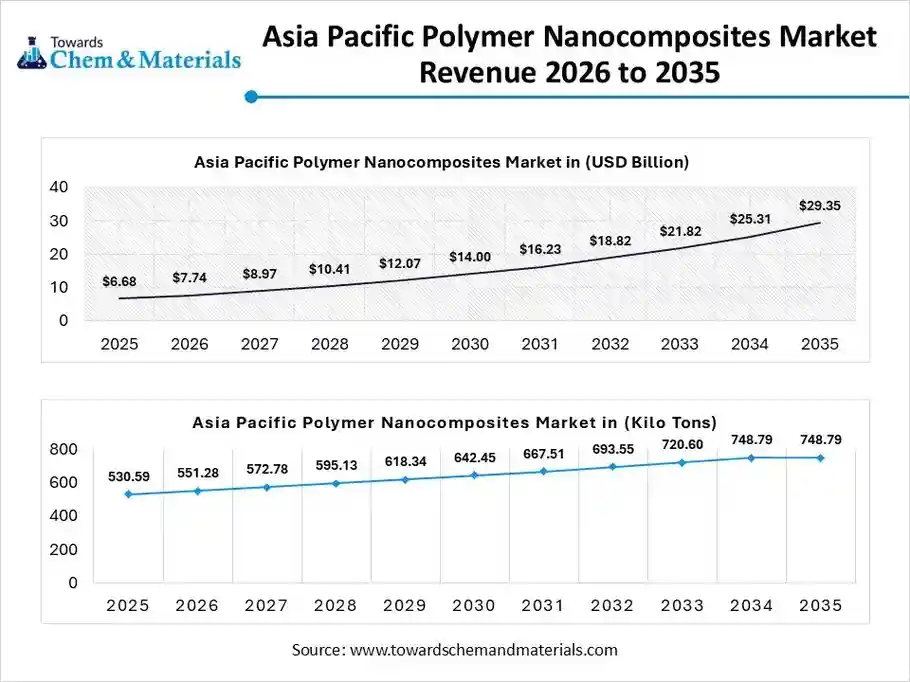
The global polymer nanocomposites market was estimated to be USD 7.74 billion in 2025 and is projected to reach USD 29.35 billion by 2035, at a CAGR of 15.98% during the forecast period. By volume, the market is projected to grow from 530.59 kilo tons in 2025 to 748.79 kilo tons in 2035. growing at a CAGR of 3.90% from 2026 to 2035.
How did Asia Pacific Dominate the Polymer Nanocomposites Market?
The Asia Pacific region leads the market, driven by extensive manufacturing and rapid industrialization i. It serves as a hub for raw nanomaterial production and large-scale manufacturing in automotive, electronics, and packaging industries. Strategic initiatives promoting advanced materials and sustainable development have strengthened its leadership, encouraging lightweight, high-performance nanocomposites for energy efficiency and miniaturization. As manufacturing advances through digital transformation and automation, the region is a key centre for innovation in nanocomposites.
China Polymer Nanocomposites Market Trends
China’s market is driven by strong demand from automotive, electronics, packaging, and construction sectors seeking lightweight, high-performance, and durable materials. Rapid industrialization and government support for advanced manufacturing and new materials are accelerating R&D and commercialization of nanocomposite technologies.
Why is North America the Fastest-Growing Region in the Polymer Nanocomposites Industry?
North America’s market is expected to grow significantly during the projected period, supported by a sophisticated industrial base that focuses on high-performance materials. Driven by precision engineering in aerospace, medical, and electronics sectors, and heavy R&D investments, the region is increasingly adopting advanced nanotechnology and innovative manufacturing. Its robust ecosystem ensures continued growth, especially as industries move toward sustainable and lightweight solutions.
U.S. Polymer Nanocomposites Market Trends
The U.S. market is rapidly expanding as lightweight, high-strength materials are increasingly adopted across the automotive, aerospace, electronics, and packaging sectors to meet performance and emissions-reduction goals. Domestic demand is bolstered by strong R&D efforts, advanced processing technologies, and strategic collaborations between industry and research institutes to commercialize next-generation nanofillers like carbon nanotubes and graphene.
More Insights in Towards Chemical and Materials:
Organosilicon Polymers Market Size to Hit USD 29.88 Bn by 2035
Conductive Polymers Market Size to Surpass USD 14.81 Bn by 2035
Ion-Conductive Polymers Market Size to Hit USD 8.75 Bn by 2035
Europe Biopolymers Market Size to Surge USD 18.23 Billion by 2035
U.S. Biopolymers Market Size to Worth Around USD 22.16 Bn by 2035
Europe Bioplastics and Biopolymers Market Size to Reach USD 34.37 Bn by 2035
U.S. Bioplastics and Biopolymers Market Size to Surpass USD 34.37 Bn by 2035
Asia Pacific Biopolymers Market Size to Worth USD 26.39 Bn by 2035
Smart Textile Polymers Market Size to Hit USD 9.63 Million by 2035
Europe Specialty Polymers Market Size to Surpass USD 72.19 Bn by 2035
Asia Pacific Specialty Polymers Market Size to Surpass USD 70.70 Bn by 2034
U.S. Specialty Polymers Market Size to Surpass USD 59.52 Bn by 2034
Asia Pacific Polymers Market Size to Surge USD 598.92 Billion by 2034
Biopolymers Market Size to Reach USD 53.68 Billion by 2034
Liquid Crystal Polymers Market Size to Hit USD 6.73 Billion by 2034
Polymers Market Size to Reach USD 1,351.59 Billion by 2034
Bio-Based Polymers Market Size to Hit USD 58.36 Billion by 2034
Medical Fluoropolymers Market Volume to Reach 13.87 Kilo Tons by 2034
Lignin-based Biopolymers Market Size to Hit USD 2.07 Bn by 2034
Fluoropolymers Market Volume to Reach 1351.23 Kilo Tons 2034
Recent Breakthroughs in the Polymer Nanocomposites Industry
- In September 2025, METiS Technologies launched NanoForge, which is recognized as the world’s first AI-driven nano-delivery platform. The platform is designed to accelerate the design and optimization of nanomaterials for drug delivery systems across various diseases.
https://www.prnewswire.com/news-releases/metis-launches-worlds-first-ai-driven-nano-delivery-platform-nanoforge-302569593.html
Top Market Players in the Polymer Nanocomposites Market & Their Offerings:
Tier 1:
- Arkema S.A.: Produces carbon nanotubes and acrylic block copolymers used as additives to boost the mechanical strength and conductivity of various resins.
- Cabot Corporation: Supplies specialty carbon black and carbon nanotube masterbatches that provide UV protection and electrical conductivity to polymer systems.
- Mitsubishi Chemical Group: Offers organic-inorganic hybrid resins and carbon-fiber-reinforced plastics designed for high-performance industrial and automotive parts.
- Nanocyl SA: Specializes in multi-walled carbon nanotubes sold as powders or masterbatches to impart electrical conductivity to plastics.
- Nanocor, Inc.: Manufactures nanoclays that enhance gas barrier properties, flame retardancy, and structural stiffness in thermoplastic resins.
- Nanophase Technologies: Produces metal oxide nanopowders and dispersions used to improve the optical and thermal performance of coatings and polymers.
- 3M Company: Utilizes specialized silica and zirconia nanofillers to create high-strength, wear-resistant dental restorative composites.
- RTP Company: Formulates custom-engineered thermoplastic compounds integrated with nanoclays or nanotubes for specific structural and anti-static requirements.
Tier 2:
- Avient Corporation
- Clariant AG
- LyondellBasell Industries N.V.
- Mitsui Chemicals, Inc.
- Toray Industries, Inc.
- Solvay S.A.
- Huntsman International LLC
- Unitika Ltd.
Polymer Nanocomposites Market Report Segmentation
This report forecasts revenue growth at global, regional, and country levels and provides an analysis of the latest industry trends in each of the sub-segments from 2019 to 2035. For this study, Towards Chemical and Materials has segmented the global Polymer Nanocomposites Market
By Polymer Matrix
- Thermoplastics
- Polypropylene (PP)
- Polyethylene (PE)
- Polyamide (Nylon)
- Polyethylene Terephthalate (PET)
- Polyvinyl Chloride (PVC)
- Polystyrene (PS)
- Polycarbonate (PC)
- Thermosets
- Epoxy Resins
- Polyurethane (PU)
- Unsaturated Polyester Resins (UPR)
- Phenolic Resins
- Elastomers and Rubbers
- Natural Rubber
- Styrene-Butadiene Rubber (SBR)
- Silicone Rubber
- Bio-based and Biodegradable Polymers
- Polylactic Acid (PLA)
- Polyhydroxyalkanoates (PHA)
- Starch-based Polymers
By Nanomaterial Type
- Nanoclays (e.g., Montmorillonite, Kaolinite)
- Carbon Nanotubes (CNTs)
- Single-Walled Carbon Nanotubes (SWCNTs)
- Multi-Walled Carbon Nanotubes (MWCNTs)
- Graphene and Graphene Oxide
- Nanofibers (e.g., Carbon Nanofibers, Polymer Nanofibers)
- Nano-oxides / Metal Oxides
- Antimony Tin Oxide (ATO)
- Zinc Oxide (ZnO)
- Titanium Dioxide (TiO2)
- Alumina (Al2O3)
- Silica (SiO2)
- Metallic Nanoparticles (e.g., Silver, Gold, Copper)
- Nanocellulose (e.g., Nanocrystalline Cellulose, Cellulose Nanofibrils)
- Polyhedral Oligomeric Silsesquioxane (POSS)
By End-Use Industry
- Packaging
- Food and Beverage Packaging
- Pharmaceutical Packaging
- Electronic Component Packaging
- Automotive
- Engine and Under-the-hood Components
- Interior and Exterior Trims
- Fuel Systems and Lines
- Tires and Sealants
- Electrical and Electronics
- Semiconductor Parts
- EMI/RFI Shielding
- Printed Circuit Boards (PCBs)
- Flexible Displays and Sensors
- Aerospace and Defense
- Structural Airframe Components
- Aircraft Interiors
- Ballistic Protection and Armor
- Energy
- Lithium-ion Battery Electrodes
- Solar Cell Encapsulants
- Wind Turbine Blades
- Biomedical and Healthcare
- Drug Delivery Systems
- Bone Tissue Engineering Scaffolds
- Surgical Implants and Tools
- Building and Construction
- Flame Retardant Panels
- High-strength Coatings and Adhesives
- Insulation Materials
By Region
North America:
- U.S.
- Canada
- Mexico
- Rest of North America
South America:
- Brazil
- Argentina
- Rest of South America
Europe:
- Western Europe
- Germany
- Italy
- France
- Netherlands
- Spain
- Portugal
- Belgium
- Ireland
- UK
- Iceland
- Switzerland
- Poland
- Rest of Western Europe
- Eastern Europe
- Austria
- Russia & Belarus
- Türkiye
- Albania
- Rest of Eastern Europe
Asia Pacific:
- China
- Taiwan
- India
- Japan
- Australia and New Zealand,
- ASEAN Countries (Singapore, Malaysia)
- South Korea
- Rest of APAC
MEA:
- GCC Countries
- Saudi Arabia
- United Arab Emirates (UAE)
- Qatar
- Kuwait
- Oman
- Bahrain
- South Africa
- Egypt
- Rest of MEA
Immediate Delivery Available | Buy This Premium Research Report@ https://www.towardschemandmaterials.com/checkout/6149
About Us
Towards Chemical and Materials is a leading global consulting firm specializing in providing comprehensive and strategic research solutions across the chemical and materials industries. With a highly skilled and experienced consultant team, we offer a wide range of services designed to empower businesses with valuable insights and actionable recommendations.
Our Trusted Data Partners
Towards chem and Material | Precedence Research | Statifacts | Towards Packaging | Towards Healthcare | Towards Food and Beverages | Towards Automotive | | Nova One Advisor | Nutraceuticals Func Foods | Onco Quant | Sustainability Quant | Specialty Chemicals Analytics | TCM Blog
For Latest Update Follow Us: https://www.linkedin.com/company/towards-chem-and-materials/
USA: +1 804 441 9344
APAC: +61 485 981 310 or +91 87933 22019
Europe: +44 7383 092 044
Email: [email protected]
Web: https://www.towardschemandmaterials.com/
 Disclaimer: The above press release comes to you under an arrangement with GlobeNewswire. NewIndiaObserver.com takes no editorial responsibility for the same.