
Global Atopic Dermatitis Therapeutic Market To Exhibit Growth at a CAGR of 7.5% by 2033 | Astute Analytica


Atopic dermatitis (AD) is a chronic inflammatory skin disorder characterized by persistent itching, redness, and irritation. Typically emerging in infancy, it affects 15-20% of children and 1-3% of adults globally. Though not infectious, atopic dermatitis has a profound impact on patients’ quality of life due to its cyclical nature of flare-ups and remissions. Intense itching often leads to scratching, which exacerbates skin damage and heightens the risk of secondary infections.
Chicago, May 28, 2025 (GLOBE NEWSWIRE) — The global atopic dermatitis therapeutic market is set for consistent growth, with revenues projected to rise from USD 15.4 billion in 2024 to USD 29.5 billion by 2033, at a CAGR of 7.5%. This momentum is fuelled by growing disease prevalence, evolving treatment modalities, and enhanced diagnostic capabilities. Continued research is aimed at identifying biomarkers to support personalized treatment, with eosinophil-derived neurotoxin (EDN) emerging as a potential indicator for disease severity and relapse prediction in resistant cases.
Genetic factors play a critical role in atopic dermatitis onset, with a 50-80% risk if one or both parents are affected. Filaggrin gene mutations which impairs skin barrier function are present in up to 30% of patients. Environmental irritants including pollution, cigarette smoke, and harsh chemicals can further weaken the skin. Inflammatory responses themselves heighten itch perception, sustaining the itch-scratch cycle and complicating management. According to a 2024 Oxford Academic report, atopic dermatitis affects an estimated 2.6% of the global population, roughly 204 million individuals, including 101 million adults and 103 million children. With the global paediatric population nearing 2 billion, the demand for effective atopic dermatitis therapies is expected to surge, supporting market expansion.
Download Sample Pages: https://www.astuteanalytica.com/request-sample/atopic-dermatitis-therapeutic-market
Initial treatment typically involves consistent moisturization and long-term symptom control. Calcineurin inhibitors like tacrolimus (Protopic) and pimecrolimus (Elidel) are recommended for patients over two years old but require careful use due to possible links to skin lymphoma. Similarly, prolonged use of high-potency corticosteroids may cause skin thinning and systemic effects. Non-steroidal options like dexpanthenol are gaining attention for their ability to improve hydration, reinforce skin barrier function, and reduce reliance on steroids when used during remission phases
The global burden of dermatological conditions, affecting approximately 1.8 billion people has made atopic dermatitis one of the most common and visible disorders. In 2022, around 223 million people were estimated to be living with atopic dermatitis worldwide, with notably high prevalence in high-income regions and among infants. As incidence increases, particularly among children, demand for more advanced and accessible therapies continues to grow. However, treatment affordability remains a major obstacle. Biologics and complex treatment regimens are expensive, and insurance coverage is often incomplete, placing financial pressure on patients. A 2019 survey by the National Eczema Association revealed that 42% of U.S. patients spent over $1,000 annually on treatment, with 8.5% exceeding $5,000. Total annual direct healthcare costs ranged from $8,936 for mild cases to $23,242 for severe cases, driven by medication, specialist consultations, and frequent emergency visits, particularly among paediatric patients during acute flares.
Despite these financial and access challenges, the atopic dermatitis therapeutic market is positioned for long-term growth. Rising clinical need, expanding treatment options, and increasing investment in research and development are expected to drive innovation and adoption. Stakeholders focus on affordability and improved patient access will be crucial in addressing unmet needs and unlocking the market’s full potential.
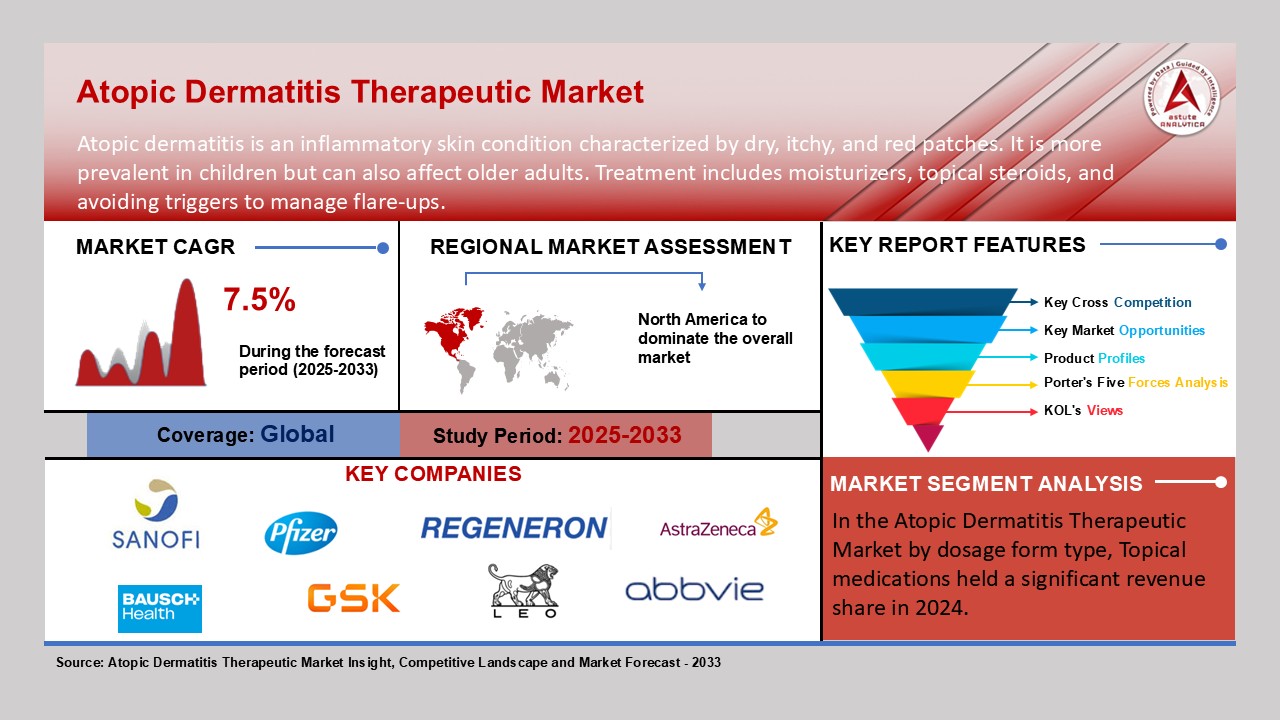
Key Findings in Atopic Dermatitis Therapeutic Market
| Market Forecast (2033) | 29.5 USD |
| CAGR | 7.5% |
| Top Driver | Escalating Global Burden of Skin Diseases |
| Top Trend | Breakthroughs in Targeted and Biologic Therapies for Atopic Dermatitis |
| Top Challenge | Soaring Costs of Innovative Atopic Dermatitis Therapies |
Emerging Opportunities in Biologics and Targeted Treatments for Atopic Dermatitis
The atopic dermatitis (AD) therapeutic market is experiencing a significant shift, driven by innovations in biologics and targeted therapies. As research continues to deepen the understanding of atopic dermatitis intricate immune mechanisms, new biologic therapies are offering highly specific treatment options that provide improved efficacy and better disease management, particularly for patients who have not responded to traditional treatments.
Biologics targeting key immune pathways, such as IL-4, IL-13, IL-22, IL-31, TSLP, and OX40-OX40L, have shown promising clinical outcomes. Many patients treated with these biologics have reached EASI-75, a significant indicator of reduced disease severity. For example, nemolizumab, an IL-31 inhibitor, has shown a notable decrease in pruritus over 64 weeks in patients with moderate to severe atopic dermatitis who had limited success with other treatments like topical therapies or antihistamines.
Ongoing research and clinical trials continue to demonstrate the potential of biologics in treating atopic dermatitis. A prominent study, a multi-center trial of abrocitinib by Pfizer, is assessing its effectiveness in patients with moderate-to-severe atopic dermatitis who have not responded to two previous biologic treatments. This reflects the expanding treatment options and the promising future of biologic therapies, which are poised to drive market growth over the long term.
As the demand for personalized and effective treatments rises, the continued progress of biologics and targeted therapies presents a major growth opportunity in the global atopic dermatitis therapeutic market. These innovations are creating new possibilities for patients and stakeholders alike, contributing to the ongoing evolution of atopic dermatitis care.
Need Custom Data Let Us Know: https://www.astuteanalytica.com/ask-for-customization/atopic-dermatitis-therapeutic-market
Global Atopic Dermatitis Market Growth: Regional Dynamics Shaping the Future
The global atopic dermatitis therapeutic market is expanding rapidly, driven by rising disease prevalence, therapeutic advancements, and evolving healthcare systems. As the need for effective treatments intensifies, regional factors are playing an increasingly critical role in shaping the market landscape. Among these, North America, Europe, Asia-Pacific, and the Middle East are emerging as key players, each contributing uniquely to the market’s growth trajectory.
North America leads the market, with a high prevalence and a strong healthcare infrastructure. In the U.S., around 16.5 million adults are affected, and the economic burden exceeds $5.3 billion annually. The region benefits from a robust pharmaceutical presence, active biologics trials, and the adoption of telemedicine. Regulatory support, including FDA’s fast-tracked approval processes, accelerates treatment innovation.
Building on North America’s momentum, Europe follows closely behind. The region is characterized by significant disease burden, with 4.4% of adults and up to 18.6% of children affected. Annual societal costs hover around USD 34 billion, highlighting the urgency for effective solutions. Europe benefits from robust R&D capabilities, a high concentration of skilled dermatologists, and efficient healthcare delivery systems, particularly in countries like Germany and the UK. Moreover, the European Medicines Agency (EMA) plays a pivotal role in promoting therapeutic advancement through streamlined regulatory pathways.
While North America and Europe maintain a strong foothold, Asia-Pacific is rapidly emerging as the fastest-growing market. This growth is propelled by increasing disease prevalence, rising healthcare expenditure, and accelerating urbanization. Demand for advanced biologics is on the rise, especially in countries such as Japan, South Korea, and China. These markets are bolstered by proactive government initiatives and expanding public-private partnerships. However, companies must navigate regional regulatory complexities and market fragmentation, requiring localized and flexible strategies to succeed.
Complementing these developments, the Middle East is steadily gaining traction in the Atopic dermatitis therapeutic landscape. Although prevalence rates are comparatively lower, the region is experiencing heightened awareness, increased healthcare investment, and rapid urban development. Countries like the UAE and Saudi Arabia are making significant strides by enhancing dermatology services and integrating biologics into treatment protocols. Global pharmaceutical companies are recognizing the region’s long-term potential, pursuing strategic collaborations to establish a presence. Nonetheless, challenges around affordability and regulatory alignment persist and must be addressed to unlock sustainable growth.
Across regions, the demand for effective Atopic dermatitis therapies are reshaping the market. Innovations in biologics, JAK inhibitors, and personalized medicine, combined with digital health solutions, are transforming care. Success will depend on navigating regional healthcare landscapes and aligning with evolving patient needs.
Recent Advancements and Key Players in the Atopic Dermatitis Therapeutic Market
Key players like Pfizer, Regeneron Pharmaceuticals, Sanofi, Leo Pharma, Cara Therapeutics, Arcutis Biotherapeutics, and Torii Pharmaceuticals are actively pushing forward new treatments for atopic dermatitis (AD). These companies are focused on developing targeted therapies that help control symptoms, reduce flare-ups, and improve patients’ quality of life.
Mar 8, 2025 – VTAMA Cream Shows Long-Lasting Results
- In March 2025, Arcutis Biotherapeutics shared promising Phase 3 results from the ADORING 3 trial, showing that 1% VTAMA (tapinarof) cream kept disease activity low in patients aged 2 and up even after they stopped using it. Even after an average of 80 days without treatment, 84% of patients still had only mild symptoms, and itching was significantly reduced, suggesting lasting relief.
Feb 2025 – Nemluvio Approved in UK & Switzerland
- Around the same time, Galderma’s Nemluvio (nemolizumab), a monoclonal antibody targeting the IL-31 receptor alpha, was approved in the UK and Switzerland for moderate-to-severe atopic dermatitis and prurigo nodularis. Clinical trials showed it improved itching, skin lesions, and sleep quality, providing a new targeted option for people with these chronic skin conditions.
Feb 2025 – Rezpegaldesleukin Gets FDA Fast Track
- Nektar Therapeutics received FDA Fast Track status for rezpegaldesleukin, a biologic designed to treat moderate-to-severe atopic dermatitis in patients 12 years and older who don’t respond well to topical treatments. The drug works by activating regulatory T cells to help control the immune response. Trials showed significant improvements within 12 weeks, with benefits lasting up to 36 weeks after treatment ended. Results from a key Phase 2b study are expected mid-2025.
Jan 2025 – Gilead & LEO Pharma Ink STAT6 Deal
- Gilead Sciences partnered with LEO Pharma on a $1.7 billion deal to develop oral STAT6 inhibitors for inflammatory diseases including atopic dermatitis. Gilead gained global rights to oral versions, while LEO keeps rights for topical products. This collaboration strengthens Gilead’s immunology pipeline and signals a major commitment to advancing dermatology treatments. Altogether, these developments are driving meaningful progress in atopic dermatitis care by bringing more effective, long-lasting therapies to patients and pushing the field forward worldwide.
Future Outlook: Transforming the Atopic Dermatitis Therpeutic Market
The atopic dermatitis (AD) therapeutic market is set for substantial growth, driven by the increasing use of biologics and JAK inhibitors. As research progresses, the development of personalized treatments will take center stage, with biomarkers expected to play a key role in optimizing therapy selection and improving patient outcomes. Clinical trials are intensifying, paving the way for more targeted and effective therapies. While injectables are gaining popularity, especially for severe cases, topical medications will continue to dominate due to their established effectiveness and lower cost. By 2030, atopic dermatitis therapies are expected to be highly individualized, with an expanded range of treatments, from biologics to advanced topical options, offering more tailored and effective solutions. The market will also see a shift toward improving access and affordability, ensuring that a broader patient population benefits from these advancements.
Key Competitors:
- Pfizer
- Regeneron Pharmaceuticals
- Sanofi
- Leo Pharma
- Arcutis Biotherapeutics
- Torii Pharmaceuticals
- Bristol Myers Squibb
- AbbVie
- GSK
- Bausch Health
- Evelo biosciences Inc
- Other Prominent Players
Market Segmentation:
By Age
- Children
- Adults
- Older Adults
By Gender
- Male
- Female
By Drug Type
- Biologics
- Non-biologics
By Drug Class
- Corticosteroids
- Calcineurin Inhibitors
-
- Pimecrolimus
-
- Tacrolimus
- PDE4 Inhibitors
-
- Crisaborole
-
- Roflumilast
-
- Difamilast
- JAK inhibitors
-
- Oral
- Upadacitinib (Rinvoq)
- Abrocitinib (Cibinqo)
- Baricitinib (Olumiant)
- Topical
- Ruxolitinib cream (Opzelura)
- Antihistamines
-
- Cetirizine
-
- Loratadine
-
- Hydroxyzine
- Biologics
-
- Dupilumab
-
- Tralokinumab (Adbry)
-
- Lebrikizumab
-
- Nemolizumab
By Route of Administration
- Topical
- Oral
- Injectable
By Distribution Channel
- Hospital & Clinics
- Pharmacies
-
- Retail Pharmacies
-
- Online Pharmacies
By Geography
- North America
- Europe
- Asia Pacific
- Middle East & Africa
- South America
Need More Info? Ask Before You Buy: https://www.astuteanalytica.com/inquire-before-purchase/atopic-dermatitis-therapeutic-market
About Astute Analytica
Astute Analytica is a global market research and advisory firm providing data-driven insights across industries such as technology, healthcare, chemicals, semiconductors, FMCG, and more. We publish multiple reports daily, equipping businesses with the intelligence they need to navigate market trends, emerging opportunities, competitive landscapes, and technological advancements.
With a team of experienced business analysts, economists, and industry experts, we deliver accurate, in-depth, and actionable research tailored to meet the strategic needs of our clients. At Astute Analytica, our clients come first, and we are committed to delivering cost-effective, high-value research solutions that drive success in an evolving marketplace.
Contact Us:
Astute Analytica
Phone: +1-888 429 6757 (US Toll Free); +91-0120- 4483891 (Rest of the World)
For Sales Enquiries: [email protected]
Website: https://www.astuteanalytica.com/
Follow us on: LinkedIn | Twitter | YouTube
CONTACT: Contact Us: Astute Analytica Phone: +1-888 429 6757 (US Toll Free); +91-0120- 4483891 (Rest of the World) For Sales Enquiries: [email protected] Website: https://www.astuteanalytica.com/
 Disclaimer: The above press release comes to you under an arrangement with GlobeNewswire. NewIndiaObserver.com takes no editorial responsibility for the same.