


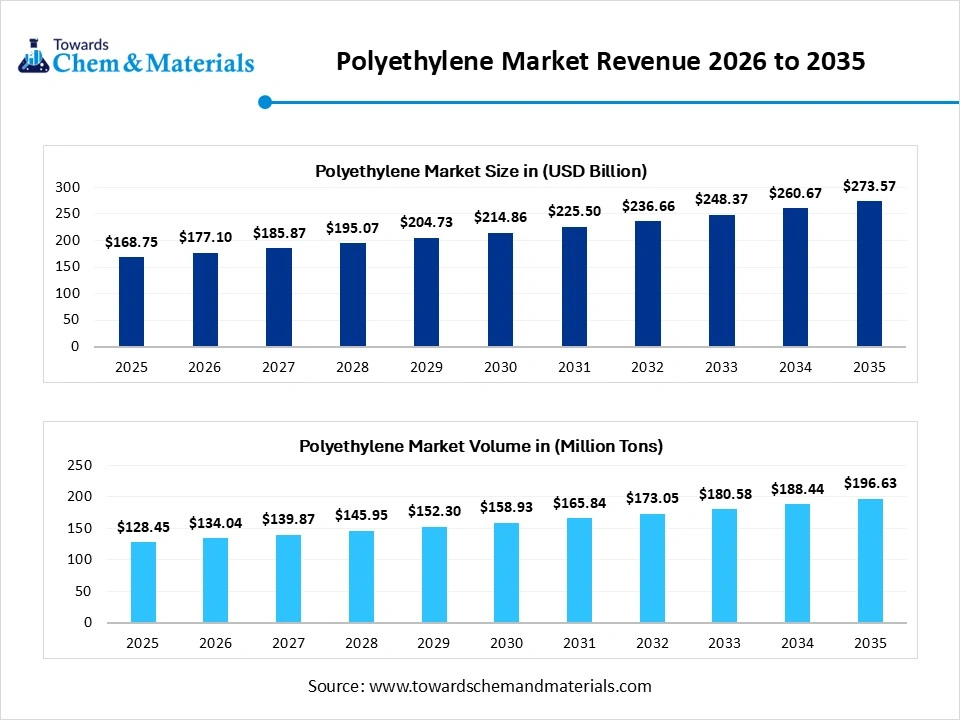
The global polyethylene market size was estimated at USD 168.75 billion in 2025 and is projected to reach USD 273.57 billion by 2035, growing at a CAGR of 4.95% from 2026 to 2035. In terms of volume, the polyethylene industry is projected to grow from 128.45 million tons in 2025 to 196.63 million tons by 2035. growing at a CAGR of 4.35% from 2026 to 2035.
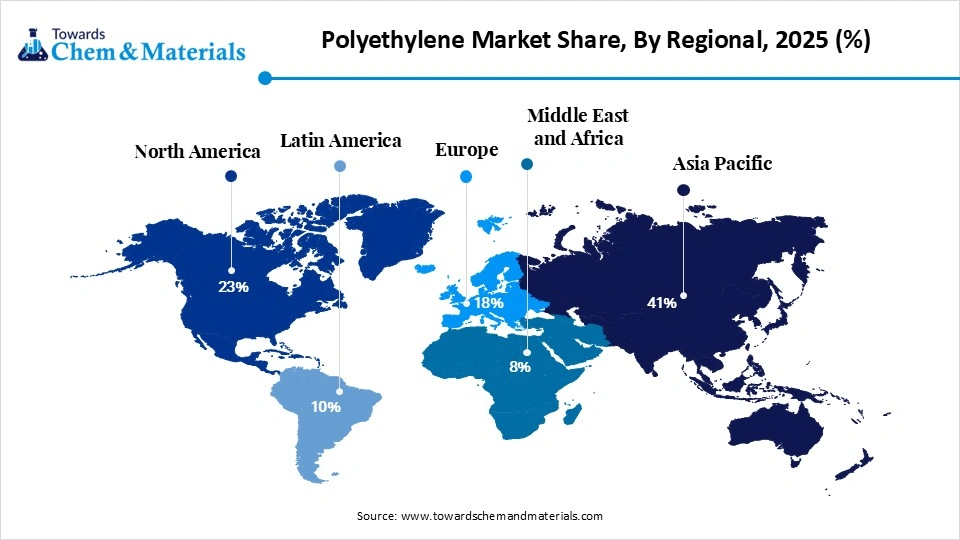
Ottawa, April 23, 2026 (GLOBE NEWSWIRE) — According to Towards Chemicals and Materials Analytics and Consulting, the global polyethylene market size was valued at USD 168.75 billion in 2025. The market is projected to grow from USD 177.1 billion in 2026 to USD 273.57 billion by 2035 at a CAGR of 4.95% during the forecast period 2026-2035 Asia Pacific dominated the polyethylene market with the largest revenue share of 41% in 2025. Polyethylene market growth is driven by rising packaging use, e-commerce expansion, and infrastructure demand, with sustainability efforts supported by the boosting production efficiency and recycling initiatives. PR-Polyethylen A study published by Towards Chemical and Materials a sister firm of Precedence Research.
Don’t miss out on business opportunities in Polyethylene Market. Speak to our analyst and gain crucial industry insights that will help your business grow. {Download a Sample Report Here@ https://www.towardschemandmaterials.com/download-sample/5545}
Polyethylene Market Report Highlights
- By region, Asia Pacific dominated the polyethylene market with 41% share in 2025 and is expected to grow at the fastest CAGR of 5.6% over the forecast period.
- By region, North America held 23% market share in 2025.
- By type, the HDPE segment dominated the market with the largest share of 42% in 2025
- By type, the LLDPE segment held 28% market share in 2025 and is expected to grow at the fastest CAGR of 5.6% over the forecast period.
- By processing technology, the extrusion segment dominated the market with a 34% share in 2025 and is expected to grow at the fastest CAGR of 5.2% over the forecast period.
- By application, packaging segment dominated the market with a 45% share in 2025 and is expected to grow at the fastest CAGR of 5.3% over the forecast period.
- By density, the high-density segment dominated the market with the largest share of 48% in 2025
- By density, the low-density segment held 35% market share in 2025 and is expected to grow at the fastest CAGR of 5.2% over the forecast period.
At a glance
- Market Estimated Size (2026): USD 177.10 Billion | CAGR (2026–2035): 4.95%
- Market Projected Size (2035): USD 273.57 Billion
- Market Volume (2025): 128.45 Million Tons (MT) | Volume CAGR (2026–2035): 4.35%
- Market Projected Volume (2035): 196.63 Million Tons (MT)
- Market Pricing (2025):
- Average Manufacturing Price: USD 1,055/ton
- Average Selling Price: USD 1,285/ton
- Pricing CAGR (2025–2035): 2.8%
Request Research Report Built Around Your Goals: [email protected]
What are the factors Driving of the polyethylene Market?
The growing demand for polyethylene is being driven by an increase in global consumption of plastics; especially for the manufacturing of products used in packaging, construction, and consumables. According to The Pew Charitable Trust, global primary production of plastics is projected to rise by more than 50% between 2025 and 2040, which will lead to continued demand for polyethylene due to its low cost, durability, and versatility when used in various applications. The primary use of polyethylene is in packaging, which accounts for approximately 40% of the total usage of polyethylene, most of which is in film and flexible applications for ecommerce and food products.
In addition to packaging applications, projects focused on infrastructure development (i.e. water pipelines, insulation, agricultural film) are contributing to increased demand for polyethylene. As sustainable development becomes a priority for governments globally, more attention is now being paid to recycling plastic products; furthermore, as the amount of waste from discarded plastics continues to increase on a global scale so does the pressure from regulations and opportunity for innovation.
Polyethylene Market Concentration & Characteristics
The polyethylene market is currently in a moderate growth phase, but expansion is picking up pace. The industry is fragmented, meaning there are many players, yet a group of large companies still holds significant influence over market direction and competition.
Major companies such as BASF SE, Borealis AG, Braskem, Dow Inc., Exxon Mobil Corporation, Formosa Plastics Corporation, INEOS Group, LG Chem, LyondellBasell Industries, Mitsubishi Chemical Corporation, MOL Group, SABIC, and Sinopec play a key role in shaping the competitive landscape. These companies continuously influence the market by developing new materials, improving production technologies, and expanding their global presence.
Innovation in the polyethylene market is moderate to high, largely driven by the growing need for sustainability and better material performance. Manufacturers are investing in advanced catalysts, bio-based raw materials, and circular polymer technologies to reduce carbon emissions and improve recyclability. In recent years, several companies have introduced bio-based polyethylene grades that offer improved strength and can be used in applications such as packaging and automotive components. Research and development efforts are steadily increasing, with a focus on lightweight packaging, mono-material films, and products that are easier to recycle.
At the same time, polyethylene faces competition from alternative materials that promise better environmental performance or specific functional advantages. Materials like polypropylene, paper-based packaging, and bioplastics are gaining popularity, especially in consumer goods and food service applications. Governments and major brands are encouraging the use of recyclable paper and compostable materials to reduce plastic waste. Bioplastics made from renewable resources are also attracting attention due to their lower environmental impact.
Polyethylene Market Opportunity
The potential for the polyethylene market is a huge opportunity for bio-based and recycled materials. This is due to heightened awareness about plastic waste and plastic pollution along with existing and planned bans on single-use plastics globally. Industries, including plastics, are trying to be less harmful to the environment and are looking for greener alternatives. This will lead to massive innovation in bio-based and recycled materials.
This shift does not only allow companies to reduce impact and EPR (Extended Product Responsibility) fines, it also allows for new, long-term growth opportunities in packaging and agriculture and even consumer goods. As sustainability becomes the norm, the adoption of low-impact and sustainable polyethylene is the direction the market is moving toward.
Where Polyethylene Makes an Impact: Everyday and Industrial Uses
Polyethylene is one of the most widely used plastics in the world, thanks to its balance of performance, durability, and affordability. Its applications stretch across multiple industries, making it a core material in both daily life and large-scale infrastructure.
- Packaging That Protects and Performs: One of the most common uses of polyethylene is in packaging. It is used to manufacture plastic bags, bottles, films, and containers. Its lightweight nature, flexibility, and resistance to moisture help protect products while keeping costs low. This makes it an ideal choice for food packaging, retail, and logistics.
- Reliable Material for Piping Systems: Polyethylene plays a critical role in infrastructure, especially in water and gas piping systems. Its strong resistance to chemicals and corrosion, combined with flexibility, allows pipes to perform well even in harsh environmental conditions. These qualities make it a dependable option for long-term use in construction and utility projects.
- Safe and Efficient in Medical Applications: In the healthcare sector, polyethylene is used to produce items such as syringes, medical tubing, and surgical drapes. Its biocompatibility, resistance to moisture, and ability to be sterilized make it suitable for maintaining hygiene and safety in medical environments.
- Versatility Across Industries; Beyond these major uses, polyethylene supports a wide range of applications due to its adaptability. Whether it’s in consumer goods, industrial equipment, or protective materials, it consistently delivers reliable performance at a cost-effective level.
What is Polyethylene Used for in Medical Applications?
Polyethylene is widely used in the medical field because it is strong, safe for the human body, and long-lasting. It plays an important role in areas such as implants, medical packaging, and prosthetic devices. In implants, polyethylene is chosen for its durability and its ability to perform well inside the body. It can handle constant movement and pressure without breaking down easily, which makes it suitable for long-term use. Polyethylene is also commonly used in packaging for medical devices. It acts as a protective and sterile barrier, helping to keep equipment clean and free from contamination until it is used.
In prosthetics, especially in hip and knee replacements, polyethylene is used as a key material. It can withstand repeated wear and movement over time while maintaining its strength and shape, which is essential for joint function. Another important advantage of polyethylene is its biocompatibility. This means it does not cause harmful reactions when it comes into contact with the human body. In addition, it resists bacterial growth, helping medical products stay hygienic.
Immediate Delivery Available | Buy This Premium Research Report (Global Deep Dive
USD 3200) https://www.towardschemandmaterials.com/checkout/5545
Polyethylene Market Report Scope
| Report Attribute | Details |
| Market size value in 2026 | USD 177.1 billion |
| Revenue forecast in 2035 | USD 273.57 billion |
| Growth rate | CAGR of 4.95% from 2026 to 2033 |
| Actual data | 2021 – 2025 |
| Forecast period | 2026 – 2035 |
| Quantitative units | Revenue in USD million/billion, Volume in Kilotons, and CAGR from 2026 to 2035 |
| Report coverage | Revenue forecast, competitive landscape, growth factors, and trends |
| Segments covered | By Type, By Processing Technology, By Application, By Density, By region |
| Regional scope | North America; Europe; Asia Pacific; Central & South America; Middle East & Africa |
| Country Scope | U.S.; Canada; Mexico; Germany; UK; France; Italy; Spain; China; India; Japan; Australia; South Korea; Brazil; Argentina; Saudi Arabia; UAE; South Africa |
| Key companies profiled | BASF SE; Borealis AG; Braskem; Dow; Exxon Mobil Corp.; Formosa Plastics; INEOS Group; LG Chem; LyondellBasell Industries Holdings B.V.; Mitsubishi Chemical Corp.; MOL Group; SABIC; China Petrochemical Corp. (Sinopec) |
For more information, visit the Towards Chemical and Materials website or email the team at [email protected]| +1 804 441 9344
How Polyethylene Strengthens Modern Construction Applications
Polyethylene has become a key material in the construction industry, offering a combination of durability, flexibility, and moisture resistance. Its ability to perform reliably in demanding environments makes it a preferred choice for a wide range of building applications.
Water Pipes for Long-Term Reliability ; Polyethylene is widely used in water distribution systems because it resists corrosion and can handle environmental stress without cracking. Its flexibility also simplifies installation, especially in uneven terrains, ensuring long-lasting and leak-resistant pipelines.
Geosynthetics for Soil Stability : In construction projects, polyethylene is used in geosynthetics to stabilize soil, control erosion, and improve drainage. Its strength and resistance to moisture allow it to reinforce weak soil structures, making it essential for roads, embankments, and land development projects.
Damp-Proof Membranes for Moisture Protection : Polyethylene acts as an effective barrier against moisture when used as a damp-proof membrane. It prevents water from seeping into foundations and walls, helping maintain structural integrity while reducing risks like mold growth and material degradation.
Insulation for Energy Efficiency : Polyethylene is used in insulation materials such as foam boards and vapor barriers. Its low thermal conductivity helps regulate indoor temperatures, improving energy efficiency in buildings while also being lightweight and easy to install.
Flooring Underlayments for Added Protection : Polyethylene sheets are commonly placed beneath flooring as underlayments. They act as moisture barriers, protecting floors from water damage and preventing mold formation—especially important in humid or moisture-prone areas.
Why Polyethylene Continues to Dominate Modern Materials
Polyethylene remains one of the most widely used plastics across industries—and for good reason. Its combination of affordability, adaptability, and performance makes it a go-to material in everything from packaging to construction. Here’s a clearer, more natural breakdown of its key advantages:
- Cost Efficiency That Drives Adoption : Polyethylene is inexpensive to manufacture, which makes it highly attractive for large-scale industrial use. This cost advantage helps keep everyday products like plastic bags, containers, and bottles affordable for consumers while allowing businesses to maintain healthy margins.
- Highly Versatile Across Industries : One of polyethylene’s biggest strengths is its flexibility in application. It can be engineered into different grades and molded into countless shapes, making it suitable for packaging, construction materials, medical supplies, and more. This adaptability allows it to meet diverse performance needs without requiring entirely new materials.
- Lightweight Yet Strong : Despite being extremely light, polyethylene doesn’t compromise on strength. This makes it ideal for packaging and transportation, where reducing weight can significantly lower shipping costs and improve fuel efficiency. It’s a smart material choice for industries focused on logistics optimization.
- Built to Last in Tough Conditions : Polyethylene is known for its durability. It resists moisture, chemicals, and harsh environmental conditions, which makes it especially useful in outdoor applications and infrastructure projects like piping systems. Its long lifespan reduces the need for frequent replacements.
- Flexible Without Breaking : Certain types, such as low-density polyethylene (LDPE), offer excellent flexibility and resistance to cracking. This makes them perfect for products like plastic bags and flexible packaging, where bending and stretching are essential without compromising integrity.
- Final Takeaway : Polyethylene’s balance of cost, performance, and versatility ensures its continued dominance across industries. Whether it’s reducing costs, improving durability, or enabling innovative product designs, this material consistently delivers practical value.
Understanding Polyethylene: Key Properties That Make It Indispensable
Polyethylene stands out as a highly reliable and adaptable material, widely used across industries due to its strong performance characteristics. Here’s a simplified and more natural look at its core properties:
- Excellent Chemical Resistance: Polyethylene can withstand exposure to a wide range of chemicals, including acids, bases, and solvents. This makes it a dependable choice in industries like chemicals and pharmaceuticals, where materials must remain stable even in harsh environments.
- High Flexibility for Diverse Uses: Certain types, especially low-density polyethylene (LDPE), are extremely flexible. This allows manufacturers to easily shape it into various forms, making it ideal for applications like plastic bags, films, and other packaging solutions that require stretchability.
- Strong Electrical Insulation: Polyethylene has impressive insulating properties, meaning it does not easily conduct electricity. Because of this, it is commonly used in electrical wiring and cable insulation, helping improve safety and performance in electrical systems.
- Durability in Tough Conditions: This material is built to last. It resists impact, wear, and environmental stress, which makes it suitable for demanding applications such as construction pipes, geomembranes, and insulation systems exposed to outdoor conditions.
- Low Friction for Smooth Operations: Polyethylene has a naturally low coefficient of friction, allowing surfaces to move smoothly against each other. This property is especially useful in machinery, conveyor systems, and packaging equipment, where reduced friction improves efficiency and reduces wear.
Immediate Delivery Available | Buy This Premium Research Report@https://www.towardschemandmaterials.com/download-sample/5545
Why Is the Asia-Pacific Region the Dominant in Polyethylene?
The Asia Pacific polyethylene market size was estimated at USD 69.19 billion in 2025 and is projected to reach USD 113.53 billion by 2035, growing at a CAGR of 5.08% from 2026 to 2035.
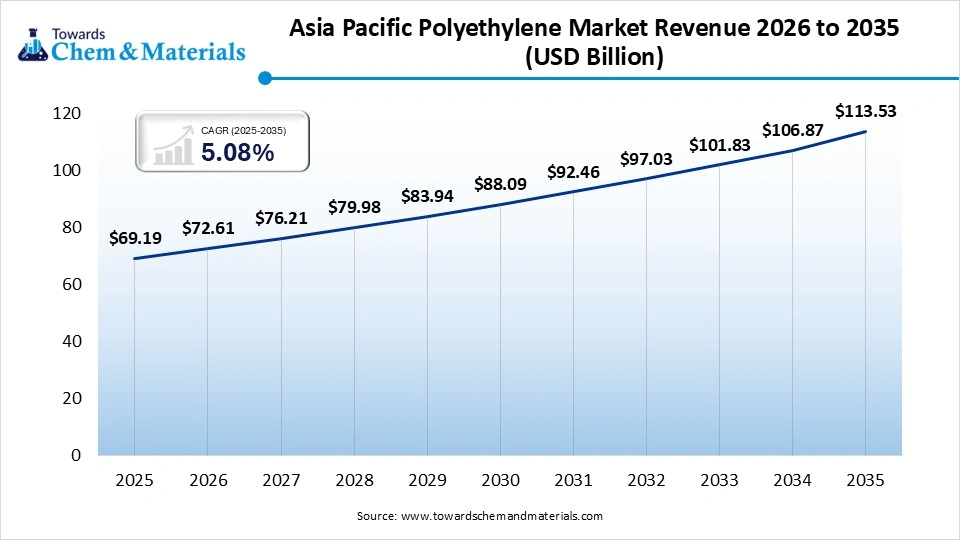
Asia Pacific has emerged as a leading player in the polyethylene industry primarily because of its high levels of production and product demand from the packaging industry and increasing numbers of urban dwellers. Many end use markets consume plastic extensively in the manufacture of goods such as food packages, construction materials and consumer products. Increased usage of polyethylene in addition to the development of e-commerce and flexible packaging trends has helped stimulate overall growth as well. Investment into expanding petrochemical production capacities and refining facilities further support the availability of these products. Lastly, an emphasis on developing domestic industrial bases and the high level of demand for lightweight, high-performance, durable materials in both the automotive and infrastructure industries support Asia Pacific’s position as the leading polypropylene producer on a global scale.
Why Is North America the Fastest-Growing Region in the Polyethylene Market?
The rapid growth of North America is due to because of new opportunities caused by shale gas production and availability of raw materials, as well as increasing levels of interest in sustainable and recyclable plastics by manufacturers and customers in the packaging and healthcare industries. Additionally, improvements in polymer processing technologies and rapid adoption of polyethylene grades with high-performance characteristics are positively affecting overall demand within this area of the market. Strong investments into circular economic initiatives and recycling facilities also positively affect overall market development, and the increasing interest in using lighter-weight materials in the automotive and construction industries is also adding to the overall growth of polyethylene usage within North America.
Europe Polyethylene Market Trends
The demand for polyethylene in Europe is increasingly shaped by a strong focus on sustainability and circular economy practices. Governments and industry groups are encouraging the use of recyclable plastics and packaging that contains more recycled material. As a result, companies are investing more in recycling facilities and advanced technologies to process used polyethylene efficiently.
At the same time, polyethylene continues to see steady demand from key sectors such as industrial packaging, construction, and automotive manufacturing. In particular, countries like Germany, France, and Italy are driving growth due to their strong industrial base and increasing use of lightweight materials in vehicles and infrastructure projects.
More Insights in Towards Chemical and Materials:
- Polyhydroxyalkanoates (PHA) Market Size to Hit USD 4,045.64 Million by 2035
- Grafted Polyolefins Market Size to Hit USD 8.28 Billion by 2035
- Piezoelectric Polymers Market Size to Surpass USD 2.89 Billion by 2035
- Polyacrylic Acid (PAA) Market Size to Hit USD 5.78 Billion by 2035
- Polyphenols Market Size to Hit USD 5.06 Billion by 2035
- Polyacrylamide Market Size to Hit USD 13.66 Billion by 2035
- Carbon Fiber Reinforced 3D Printing Polymers Market Size to Surpass USD 1,202.28 Million by 2035
- Electric Field responsive Polymers Market Size to Hit USD 6.63 Bn by 2035
- Cellulose Nanocrystal Reinforced Biopolymers Market Size to Hit USD 1,311.67 Mn by 2035
- Fluorinated Polymers Market Size to Hit USD 15.37 Billion by 2035
- Thermochromic Polymer Films Market Size to Surpass USD 1,381.50 Mn by 2035
- Polypyrrole Bioelectronics Market Size to Hit USD 1,424.08 Mn by 2035
- Conductive Polymer Fibers Market Size to Hit USD 1,835.37 Mn by 2035
- Biodegradable Electronics Polymers Market Size to Hit USD 392.32 Million by 2035
- Ethylene Alpha Olefin Copolymers Market Size to Surpass USD 133.36 Bn by 2035
- Polyethylene Terephthalate Films Market Size to Surpass USD 110.48 Bn by 2035
- Wire and Cable Polymer Market Size to Hit USD 28.19 Bn by 2035
- Polybags Market Volume to Surpass 29.22 Million Tons by 2035
- Polypropylene Yarn Market Size to Reach USD 34.01 Billion by 2035
- Polyurethane Dispersion Market Size to Surpass USD 8.12 Billion by 2035
- Olefin Polymerization Catalyst Market Size to Surpass USD 9.15 Bn by 2035
- Polyethylene Terephthalate Films Market Size to Surpass USD 110.48 Bn by 2035
- Amorphous Polyethylene Terephthalate Market Size to Hit USD 120.82 Bn by 2035
- Polyethylene Furanoate (PEF) Market Size to Hit USD 3,233.78 Mn by 2035
- Polyethylene Terephthalate Catalyst Market Size to Hit USD 1,321.75 Mn by 2034
- U.S. Recycled Polyethylene Terephthalate Market Size to Surpass USD 12.08 Bn by 2035
- Linear Low-Density Polyethylene (LLDPE) Market Size to Reach USD 118.69 Bn by 2034
- Polyethylene Terephthalate (PET) Market Size to Reach USD 68 Bn by 2034
- Polyethylene Glycol (PEG) Market Volume to Exceed 788,565.1 Tons by 2034
- Polyethylene Wax Market Size to Reach USD 3.56 Bn By 2034
- Mechanical & Chemical Recycling of Polyethylene Market Size, Share | CAGR of 10.29%
- Low-Density Polyethylene (LDPE) Market Size to Reach USD 80.34 Billion by 2034
- Specialty Chemicals Market Size Worth USD 2.03 Trillion by 2035
- Polyethylene Market Size to Reach USD 273.57 Billion by 2035
- Bioplastics Market Size, Share & Trends Analysis Report by 2026-2035
- Aquaculture Market Size to Surpass USD 626.25 Billion by 2035
Polyethylene Market Top Key Companies:
- BASF SE
- Borealis AG
- Braskem
- Dow
- Exxon Mobil Corporation
- Formosa Plastics
- INEOS Group
- LG Chem
- LyondellBasell Industries Holdings B.V.
- Mitsubishi Chemical Corporation
- MOL Group
- SABIC
- China Petrochemical Corporation (Sinopec)
Recent Developments
- In February 2026, NOVA Chemicals introduced new recycled polyethylene grades in North America, enhancing circular plastic solutions and supporting sustainable packaging demand with advanced recyclate-based materials for various industrial and consumer applications.
- In July 2025, Braskem launched South America’s first commercial sale of chemically recycled circular polyethylene, supplying Copobras for pet food packaging, marking a major step toward circular economy adoption and sustainable resin commercialization.
- In November 2025, Borouge introduced the first UAE-made healthcare-grade LDPE, enabling local production of medical packaging like IV bottles and ampoules, strengthening regional supply chains across the Middle East, Asia, and Africa.
- In June 2025, Dow Inc. announced the launch of a new LLDPE/HDPE production unit online at Freeport, lifting Gulf Coast resin output and export volumes. The startup supports packaging and film supply chains and improves regional competitiveness for US resin exports.
- In February 2025, ExxonMobil began test runs at its Huizhou petrochemical complex, commissioning a 1.6 million tons per annum cracker and downstream LLDPE trains with a combined capacity of about 1.2 million tons per annum. The facility materially increased Asian LLDPE and flexible-film resin capacity.
Polyethylene Market Report Segmentation
This report forecasts revenue growth at global, regional, and country levels and provides an analysis of the latest industry trends in each of the sub-segments from 2019 to 2035. For this study, Towards Chemical and Materials has segmented the global Polyethylene Market
By Type
- High-Density Polyethylene (HDPE)
- Blow Molding Grade
- Injection Molding Grade
- Pipe Grade
- Low-Density Polyethylene (LDPE)
- Film Grade
- Coating Grade
- Linear Low-Density Polyethylene (LLDPE)
- C4 LLDPE
- C6 LLDPE
- C8 LLDP
- Ultra-High Molecular Weight Polyethylene (UHMWPE)
- Cross-linked Polyethylene (PEX)
By Processing Technology
- Injection Molding
- Blow Molding
- Extrusion
- Film Extrusion
- Sheet Extrusion
- Pipe Extrusion
- Rotational Molding
- Others
By Application
- Packaging
- Flexible Packaging
- Rigid Packaging
- Construction
- Pipes & Fittings
- Insulation
- Automotive
- Agriculture
- Consumer Goods
- Electrical & Electronics
By Density
- High Density
- Medium Density
- Low Density
By Regional
- North America
- Europe
- Asia Pacific
- Latin America
- Middle East & Africa
Immediate Delivery Available | Buy This Premium Research Report@
https://www.towardschemandmaterials.com/checkout/5545
About Us
Towards Chemical and Materials is a leading global consulting firm specializing in providing comprehensive and strategic research solutions across the chemical and materials industries. With a highly skilled and experienced consultant team, we offer a wide range of services designed to empower businesses with valuable insights and actionable recommendations.
To find out more, visit www. Towards Chemicals and Materials Analytics and Consulting ™.com or follow us on Twitter, LinkedIn
Contact:
Towards Chemicals and Materials Analytics and Consulting
USA: +1 804 441 9344
APAC: +61 485 981 310 or +91 87933 22019
Europe: +44 7383 092 044
Email: [email protected]
Visit Our Website: https://www.towardschemandmaterials.com/
 Disclaimer: The above press release comes to you under an arrangement with GlobeNewswire. NewIndiaObserver.com takes no editorial responsibility for the same.